
How to Convert the Number Ten from Decimal to Binary
Learn how the decimal number ten converts into binary 🔢, the basics of binary code 💻, and its real-world uses in Nigerian tech 🌍.
Edited By
Charlotte Hill
In the world of computing and digital business, understanding how to convert decimal numbers to binary is more than just an academic exercise—it’s a practical skill. Decimal numbers, those everyday figures we use in trading, finance, or even running a business, are different from binary numbers, which computers use to process data. Grasping this conversion can give investors, brokers, and entrepreneurs clearer insight into how technology interprets numbers behind the screen.
Decimal is the base-10 system, counting from zero to nine before moving to the next digit. In contrast, binary is base-2, using only 0s and 1s. For instance, the decimal number 13 translates to 1101 in binary. This difference matters because binary underpins all digital operations—from stock trading platforms to financial software.
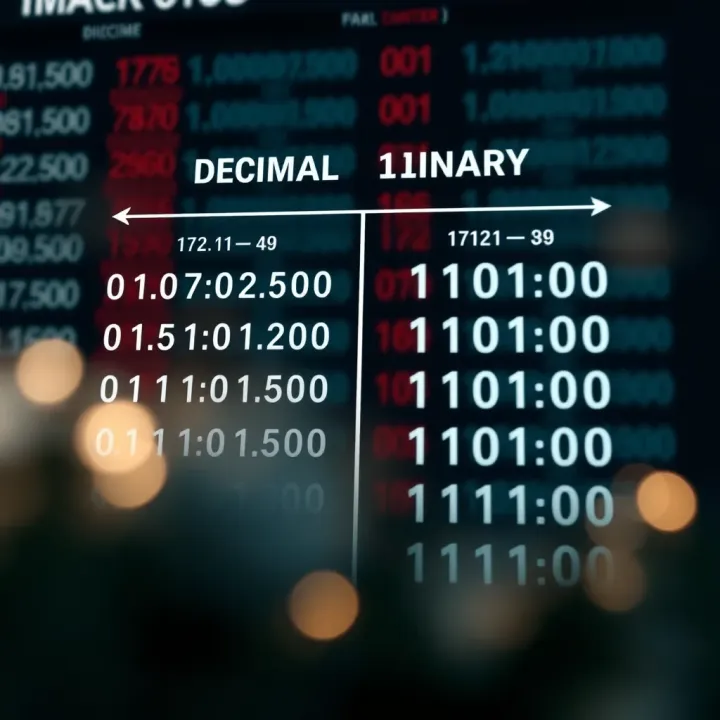
Knowing how to switch between decimal and binary numbers offers a tangible advantage. It helps decode the logic behind digital systems and sharpens your grasp of data handling in fintech and other tech-driven sectors.
Here’s a straightforward method to convert a decimal number to binary manually:
Divide the decimal number by 2.
Record the remainder (0 or 1).
Divide the quotient again by 2.
Repeat until the quotient is 0.
The binary number is the series of remainders read from bottom to top.
For example, converting the decimal 22:
22 ÷ 2 = 11 remainder 0
11 ÷ 2 = 5 remainder 1
5 ÷ 2 = 2 remainder 1
2 ÷ 2 = 1 remainder 0
1 ÷ 2 = 0 remainder 1
Read from bottom to top, 22 in decimal equals 10110 in binary.
Understanding this process not only aids manual calculations but improves your confidence when working with digital financial tools. Automated converters on platforms like Paystack or Flutterwave use the same principles internally.
Mastering decimal to binary conversion bridges the gap between everyday numbers you manage and the binary codes computers process. This foundation supports better decision-making in the data-driven Nigerian market, where technology keeps reshaping how business and investments operate.
Grasping how decimal and binary number systems work sheds light on everyday transactions and powerful digital processes. For traders, investors, and entrepreneurs in Nigeria, understanding these systems is not just academic; it's practical. For example, digital platforms handling transactions rely on binary coding, while most business figures use decimal numerals. Connecting these two systems improves comprehension of backend operations and security protocols.
The decimal system, or base-10, is the counting method most people use daily. From calculating prices at a mama put to setting budgets for ember months, everything revolves around digits zero to nine. Its ubiquity makes it second nature — whether you're adding ₦3,500 to a ledger or negotiating a tokunbo car price.

In decimal, every digit’s position determines its value. Take the number 2,315: the '5' is in the units place, '1' in the tens, '3' in the hundreds, '2' in the thousands. This positional system allows us to write large numbers efficiently and makes calculations smoother. Traders, for instance, rely on place values when counting stock quantities or forecasting sales.
The system is called base-10 as it uses ten digits (0–9), each position representing powers of ten. For example, 427 means (4 × 10²) + (2 × 10¹) + (7 × 10⁰). This base ties to humans having ten fingers—a natural counting aid historically universal. Understanding this helps in appreciating the contrast with binary's base-2, which computers use.
The binary system uses just two digits: 0 and 1. Each digit corresponds to increasing powers of two rather than ten. For instance, the binary number 101 represents (1 × 2²) + (0 × 2¹) + (1 × 2⁰), which equals 5 in decimal. This simplicity allows computers to process data reliably using electrical signals representing on and off states.
All digital devices, from smartphones down to the okada dispatch apps, rely on binary to operate. Inside microchips, millions of transistors switch on and off, encoding instructions and numbers in binary. A smartphone’s camera, for example, captures images stored as vast arrays of binary data, which apps process fast because of this system’s design.
While decimal suits human usage due to familiarity and ease of representing quantity, binary excels in technology because of its simplicity and resilience. Binary digits (bits) reduce hardware complexity and errors. However, converting between decimal and binary is necessary to link human inputs with machine operations — a crucial step when writing software or analysing data encoded digitally.
Understanding both decimal and binary systems empowers professionals in varied fields to bridge the gap between human logic and machine mechanics, enhancing decision-making, troubleshooting, and innovation.
Manual conversion from decimal to binary remains a fundamental skill, especially for traders, investors, brokers, and analysts who often interact with computing systems or fintech platforms. Understanding this method helps demystify how digital devices process numerical data, and it’s useful when software tools are unavailable or when you want to ensure accuracy in critical operations.
The division by two method is the most straightforward manual approach to convert decimal numbers into binary. It involves dividing the decimal number repeatedly by 2 and tracking the remainders from each division. This method is practical because it breaks the conversion into simple steps anyone comfortable with basic arithmetic can follow.
Recording the remainders is key to this process. Each remainder forms a binary digit (also called a bit), but the trick is in the order. You start recording remainders from the first division, but the final binary number is obtained by reading these remainders from bottom to top. This reverses the sequence and ensures the binary number correctly reflects the decimal value.
You stop dividing when the quotient becomes zero. This stopping condition ensures you've fully broken down the decimal number into binary form without missing any digits or continuing unnecessarily. This clear end-point makes the method efficient and easy to verify.
Choosing a decimal number to convert should be practical and relevant—for instance, converting a transaction ID like 45 helps grasp the usefulness of this conversion in real-life fintech operations. A double-digit number strikes a good balance between complexity and clarity for illustration.
Applying the division method to 45 means dividing 45 by 2, which gives 22 as quotient and 1 remainder. You continue dividing successive quotients by 2 until you reach zero. Each remainder is noted as a binary digit. For 45, the sequence of remainders will be recorded down the steps.
Reading the binary result means taking the recorded remainders from last to first. For 45, reading from the last division remainder up to the first produces the binary number 101101. This binary form is what computers use to represent the decimal 45 in their internal processes.
Mastering this step-by-step manual division strengthens your grasp of digital number systems, enabling you to confidently interpret or troubleshoot numerical data on any computing or financial platform.
Divide the decimal number by 2 repeatedly.
Record the remainder after each division.
Stop when quotient is zero.
Read remainders from bottom up to get the binary number.
This manual method complements digital tools, giving you a clear understanding even when algorithms work behind the scenes, which is vital for anyone serious about technology-driven investments or trade analysis.
Converting decimal numbers to binary by hand is educational but can be time-consuming, especially with larger figures common in trading or programming. Tools and software speed up this process, ensuring accuracy and efficiency. Traders and analysts who deal with complex number systems benefit greatly from these resources, reducing errors and freeing time for analysis.
Recommended websites: Several trustworthy websites offer free binary conversion services. These platforms are easy to use, require no installation, and provide instant results. For example, tools on sites like RapidTables or CalculatorSoup are widely trusted. Such websites are valuable for quick checks or when you need to confirm manual calculations without opening programming tools.
How to input numbers: Inputting numbers is straightforward. You enter your decimal number in the box provided, ensuring you avoid leading spaces or symbols that might cause errors. Some tools accept large numbers without issues, while others may have limits—users should ensure their number fits within the allowed range. For Nigerian users, entering numbers related to ₦ values like transaction amounts or stock prices can be handled seamlessly.
Interpreting output: After input, the site displays the binary equivalent clearly, often alongside additional formats like octal or hexadecimal. The binary output usually appears as a string of 1s and 0s without spaces. For beginner users, understanding that the leftmost digit is the most significant bit is essential. Some converters show step-by-step reasoning or provide the binary output grouped in bytes for easier reading.
Basic code snippets in Python: Python offers simple commands to convert decimal to binary, making it a favourite for programmers. Writing bin(number) converts an integer to its binary representation. For example, bin(25) returns '0b11001'. Such snippets help automate conversions in software development or data analysis.
python
number = 45 binary_form = bin(number) print(binary_form)# Output: 0b101101
**Tools available on Nigerian platforms**: Nigerian tech hubs and startups increasingly integrate conversion utilities in apps and APIs. Platforms like Flutterwave and Paystack embed tools that handle number conversions behind the scenes for transaction processing or encryption. Local developers can access libraries and SDKs supporting binary operations, making this knowledge practical and directly applicable.

**Benefits for programmers**: Using code for conversions avoids human error and handles bulk data efficiently. Programmers working on fintech products or digital security benefit from implementing these functions to format data properly. Plus, scripts can be packaged into larger programs, allowing seamless integration with other business processes like algorithmic trading or automated reporting.

> Employing software and programming saves time and avoids common mistakes in converting decimal to binary, especially when handling large or complex numbers encountered daily in Nigerian businesses and tech sectors.

## Common Errors and How to Avoid Them

When converting from decimal to binary, even a small slip can lead to incorrect results. Traders, analysts, and entrepreneurs who deal with data and coding must watch out for these common errors to avoid costly mistakes. Understanding typical pitfalls not only streamlines the conversion process but also sharpens your grasp of how digital information works under the hood.

### Misreading Remainders

One frequent mistake is reading binary digits in the wrong order. During manual conversion by division, you record remainders of successive divisions by two. The key is to write these remainders starting from the last remainder obtained to the first. For example, converting the decimal number 13 gives remainders 1, 0, 1, 1 when read backward. Reading them forward instead will give a wrong binary number, causing errors downstream in calculations or coding.

Double-checking your steps ensures accuracy. After listing the binary digits, it helps to convert back to decimal to verify your work. This quick check confirms if the binary number represents the original decimal value. Such validation is especially useful when working on investment models or algorithm designs, where accurate data processing is crucial.

### Confusing Binary with Other Bases

Binary is one of several number systems; understanding how it stands apart from octal (base 8) and hexadecimal (base 16) prevents confusion. While binary uses only 0 and 1, octal uses digits 0 through 7, and hexadecimal employs 0–9 plus A–F. These differences affect how data is represented and processed, with hexadecimal often used in programming for compactness, whereas binary is fundamental for hardware-level operations.

Knowing when to use each system adds clarity to your work:

- **Binary** is ideal for low-level computing tasks, such as setting flags or controlling hardware where two states suffice.
- **Octal** is less common now but still appears in some computing systems; it groups binary digits in sets of three for easier reading.
- **Hexadecimal** is preferred for writing memory addresses and colour codes due to its concise format.

For traders and developers in Nigeria, this knowledge helps when interpreting software outputs, debugging code, or working with fintech systems. Confusing these bases can lead to costly misunderstandings, such as reading a hexadecimal value as binary and making wrong decisions based on faulty data.

> Avoiding these errors not only saves time but also protects the integrity of your data work and investments, ensuring confident decision-making in tech-driven environments.


## Why Converting to Binary Matters in Nigeria

Binary numbers form the backbone of computing and digital communication, so understanding how to convert decimal numbers to binary has practical implications for Nigeria’s growing tech landscape. From education to business, having a grip on binary conversion helps digital literacy, boosts programming skills, and supports innovation in a country where technology is rapidly evolving.

### Relevance in Tech Education

**Schools and computer studies**: Nigerian schools, especially in computer science and ICT classes, introduce students to the basics of number systems early on. Grasping binary numbers prepares learners to handle programming tasks and understand how software operates. For instance, when students explore how computers store or process information — be it in secondary schools or universities — they often rely on binary comprehension for practical coding and data representation exercises.

This foundational knowledge extends beyond classrooms. As more Nigerian schools incorporate coding camps and digital skills programmes, being able to convert decimal to binary becomes part of essential digital literacy. It sets a base for advanced learning in coding languages, networking, and hardware technology.

**Understanding coding basics**: Most programming languages require understanding binary concepts because computers interpret commands at the hardware level as binary signals. Nigerian developers, whether they’re building apps, websites, or fintech solutions, benefit from knowing how decimal values map into binary.

For example, when an algorithm manipulates data or handles low-level bitwise operations, knowing the binary representation helps avoid errors and optimise performance. Programmers in Lagos’s tech hubs or Abuja’s growing software industry often leverage this knowledge to improve software efficiency and troubleshoot issues quicker.

### Application in Local Tech Businesses

**Fintech and software development**: Nigeria’s fintech sector is booming, with startups processing millions of transactions daily. Binary conversion is essential here because computers in payment platforms or mobile banking apps process numbers internally in binary.

Understanding binary helps developers design more secure and efficient financial products. For example, tasks like encryption, transaction validation, or QR code generation depend heavily on converting data between decimal and binary to ensure accuracy and security.

Fintech firms like Paystack or Flutterwave employ programmers and analysts who regularly engage with such concepts, driving Nigeria’s digital economy forward.

**Implications for hardware use**: Many Nigerian enterprises rely on hardware like POS terminals, ATMs, or even servers that operate on binary logic. Tech professionals maintaining these devices must understand how decimal inputs convert to binary instructions the hardware understands.

For example, troubleshooting a faulty POS terminal often requires familiarity with how input codes correspond to binary signals within the device’s processor. Similarly, understanding binary assists in optimising hardware performance, effective memory use, and designing local tech solutions tailored to Nigeria’s infrastructural conditions.

> Mastering decimal to binary conversion is not just academic; it’s a skill with direct benefits across Nigeria’s education system and vibrant tech industries. Building this knowledge helps professionals stay competitive and innovate in a digital economy on the rise.

By appreciating the practical relevance of binary conversion in education and business, Nigerians can better harness technology to solve problems, deliver efficient services, and compete globally.Learn how the decimal number ten converts into binary 🔢, the basics of binary code 💻, and its real-world uses in Nigerian tech 🌍.

Master binary subtraction with clear steps, practical tips, and common pitfalls explained 🔢 Learn to subtract binary numbers confidently and accurately today!

Learn how binary number subtraction works in computing 🖥️. Explore step-by-step methods, borrowing, two's complement, plus tips to avoid common mistakes 🔢.
Learn how to add binary numbers step-by-step 🧮, essential for digital electronics and computing. Perfect for those wanting to master binary arithmetic basics and beyond.
Based on 5 reviews